Comparison
Gaussian vs CrowdStrike, SentinelOne & Lakera
Named, honest comparisons. What they do well, what they miss for AI agents, and how Gaussian adds the missing layer.
The core difference
Your EDR blocks malicious processes.
Gaussian knows which ones were AI-initiated.
Modern EDR/XDR platforms block known-bad process chains and correlate threat signals. Gaussian adds what they can't: agent identity. It classifies whether execution was AI-initiated or human-initiated, and applies different policy based on that distinction.
Capability comparison
Knows the actor is AI
Code-signing identity verification per-process
Blocks runtime actions
Sync AUTH on exec, file open, and network
Correlates multi-step chains
Causal graph with DAG traversal + BFS
Applies different AI vs. human policy
Parent-chain signing-ID classification
Governs MCP tool calls
Classifies MCP runtimes by process lineage
Supply chain install gate
AUTH_EXEC intercept + postinstall evaluation
Behavioral detection rules
25 production rules across 6 tiers, IR-compiled
macOS native (no KEXT)
ES + NE + DNS Proxy system extensions
Real-time classification
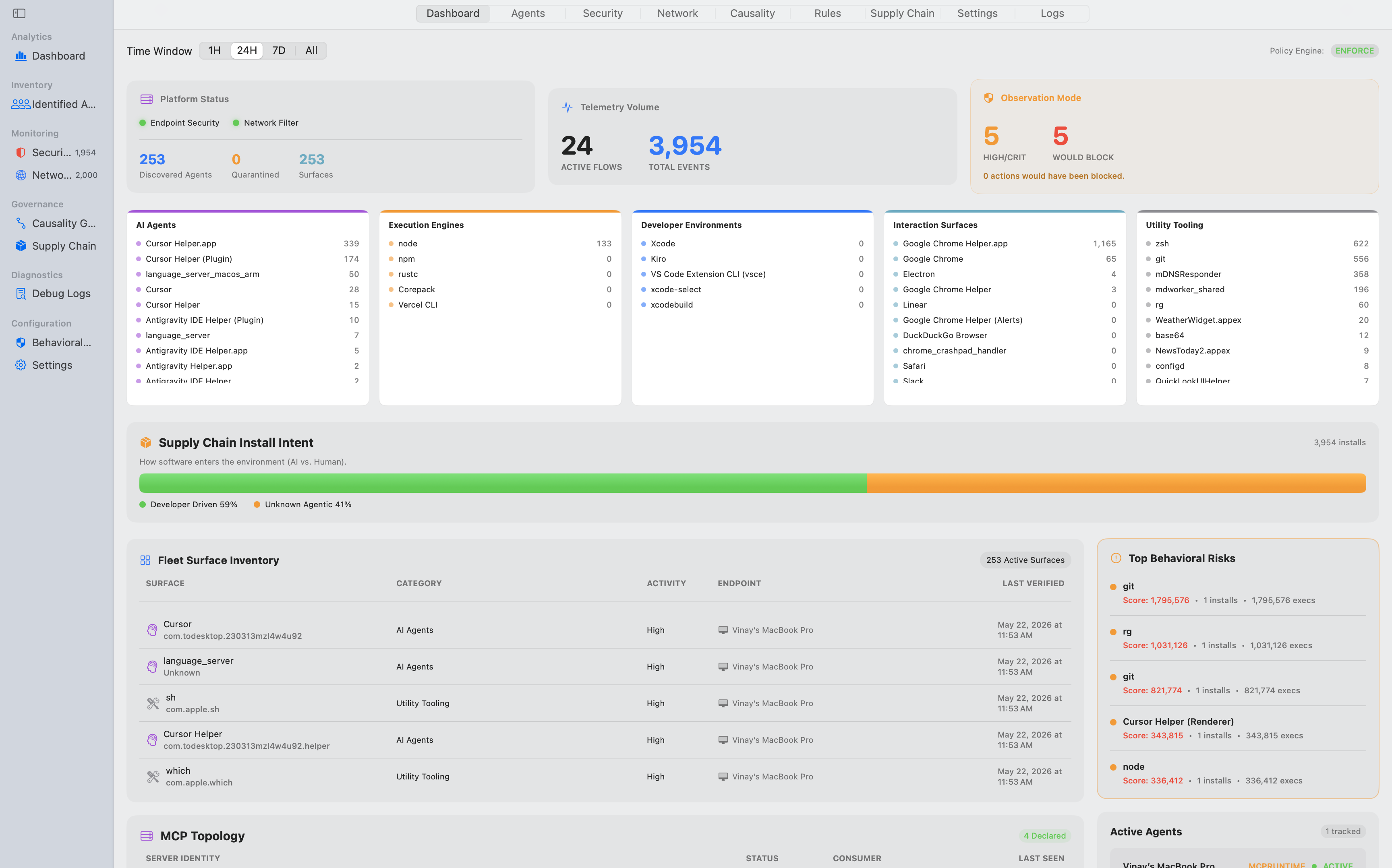
253 agents classified in real time — AI Agents, Execution Engines, Developer Environments, Interaction Surfaces, Utility Tooling
How Gaussian sees execution
What EDR sees
node ← normal processopen ~/.aws/credentials ← allowedconnect api.evil.io:443 ← allowedSame policy whether human or AI spawned this process.
No agent context. No causal chain.
What Gaussian sees
Cursor → node mcp-server.js agent: aiClientopen ~/.aws/credentials → readSensitiveFileconnect api.evil.io:443 → networkConnectExternalCausal graph detected: AI agent read credentials → connected external. Quarantine + VerdictCache flush.
Enforcement flow
Cursor spawns
node mcp-server.jsGaussian classifies
agent: aiClient → mcpRuntimenode reads
~/.aws/credentialsnode curls
external-api.ioGaussian verdict
QUARANTINE — secret→egress chainFits your stack
EDR co-existence
Apple's multi-client ES API. Runs alongside CrowdStrike, SentinelOne, Defender.
SIEM output
Splunk HEC, Datadog API, syslog. Native integration, not just webhooks.
MDM deployment
PKG + config profiles. Jamf, Kandji, Mosyle — standard fleet tools.
MITRE ATT&CK
Every behavioral rule maps to ATT&CK technique IDs.
Honest gaps
macOS only
Gaussian uses Apple's ES + NE APIs. Windows and Linux are on the roadmap but not shipped.
Behavioral detection is async
Sync enforcement blocks the first gate. Behavioral rules catch the next action in the chain, not always the first.
Early stage
Gaussian is in active development with design partners. Enterprise features are shipping, not all GA.
Named comparisons
Gaussian vs. CrowdStrike Falcon
EDR / XDRWhat CrowdStrike Falcon does well
Fleet-wide threat detection, known-bad process blocking, cloud workload protection. Industry-leading enterprise EDR with Threat Graph correlation.
What they miss for AI agents
Cannot distinguish AI-initiated vs. human-initiated execution of the same binary. Applies identical policy to 'node' whether spawned by Cursor or a developer in Terminal. No MCP tool call governance. No agent skill auditing.
What Gaussian adds
Agent identity classification via code-signing chain. Different policy for AI-spawned processes. MCP tools/call interception. Behavioral rules with agentic session context.
Coexistence
Yes — Apple's multi-client ES API supports both simultaneously. No conflict.
Gaussian vs. SentinelOne Singularity
EDR / XDRWhat SentinelOne Singularity does well
Autonomous endpoint protection with AI-driven threat detection, rollback capabilities, and Storyline correlation across process trees.
What they miss for AI agents
Storyline correlates process ancestry but doesn't classify whether the root actor is an AI agent. No differentiated policy for AI-initiated execution chains. No MCP or SKILL.md governance.
What Gaussian adds
Parent-chain signing-ID classification (aiClient, mcpRuntime, devTool). Secret-read → egress causal graph rules that understand agentic session context.
Coexistence
Yes — both register as independent ES clients. Independent AUTH decisions.
Gaussian vs. Lakera Guard / Prompt Injection Tools
Prompt GuardrailsWhat Lakera Guard / Prompt Injection Tools does well
API-layer prompt injection detection. Inspects prompts and model responses before they reach or leave the LLM. Protects against direct and indirect prompt injection.
What they miss for AI agents
Operates at the model API boundary, not the OS layer. Cannot see what happens after the model responds — process spawns, file access, credential reads, network connections, MCP tool execution.
What Gaussian adds
OS-level enforcement of what the model actually does. Even if a prompt injection bypasses the guardrail, Gaussian blocks the resulting dangerous execution.
Coexistence
Complementary — Lakera protects the model input/output; Gaussian protects the OS execution layer.
Gaussian vs. Snyk / Semgrep
SAST / SCAWhat Snyk / Semgrep does well
Static analysis of source code and dependency vulnerabilities. Scans codebases for known CVEs, insecure patterns, and license compliance issues.
What they miss for AI agents
Analyzes code at rest, not execution at runtime. Cannot detect that an AI agent is actively reading credentials, spawning curl, or running unapproved postinstall scripts.
What Gaussian adds
Runtime execution governance. Intercepts what actually runs on the machine, not just what's written in source files.
Coexistence
Complementary — Snyk/Semgrep covers code-level risks; Gaussian covers runtime execution risks.
Comparison FAQ
How does Gaussian compare to CrowdStrike Falcon for AI agent security?
CrowdStrike Falcon is an enterprise EDR/XDR that monitors process trees and blocks known-bad signatures. Gaussian adds what Falcon cannot: AI agent identity classification, different policy for AI-initiated vs human-initiated execution of the same binary, and MCP tool call governance.
Is Gaussian a replacement for SentinelOne?
No. Gaussian complements SentinelOne by adding an AI-aware policy layer. Both use Apple's multi-client Endpoint Security API and coexist without conflict. SentinelOne blocks known threats; Gaussian enforces agent-specific behavioral policy.
How does Gaussian differ from Lakera Guard or prompt injection tools?
Lakera Guard and similar prompt guardrails operate at the model API layer — they inspect prompts before they reach the LLM. Gaussian operates at the OS layer — it intercepts what happens after the model responds: process spawns, file access, network connections, and MCP tool calls.
Want to see the proof?
Running AI agents on Mac at scale? We'll tune policy with you.
Design partners →